Prices for the parts of a voice agent have fallen sharply: OpenAI's realtime audio list price dropped 68% between October 2024 and August 2025, and ElevenLabs cut conversational plan prices about 50% in February 2025. But vendors meter different things, from characters of speech to orchestration minutes to avatar credits, so advertised rates do not compare directly. Judge a voice or video agent by cost per verified resolution, and add a face only when video measurably helps people finish the job.
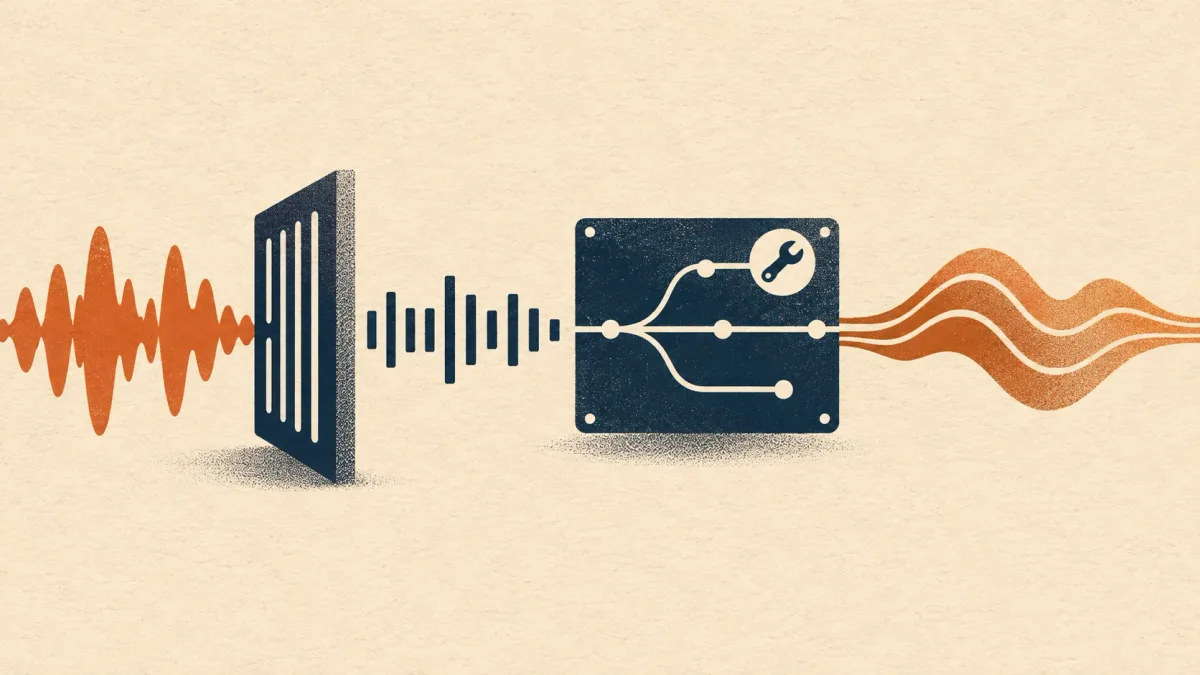
A cloned voice can narrate a training video without understanding a word of it. A voice agent can reschedule a visit without ever showing a face. A live video agent can do the same while looking at a shared screen and speaking through a synchronized avatar. All three may sound like the same person, but they are different products, with different costs, risks and ways to stand out.
This analysis is for owners and operations leads deciding what to buy as prices fall. It draws on vendors' public pricing pages, product documentation and published research as of November 2026, and every figure links to its source. It separates what got cheaper from what did not, and ends with what that means for a small business.
That distinction explains the price war better than a timeline of phone bots. People have long paid for recognizable voices and believable faces. What changed is that recognition, synthesis, reasoning and rendering became things a developer could buy separately or as a bundle. A speech supplier can now sell agents; a video-production company can sell live conversations; a cloud platform can supply a model, a face and a route into the enterprise. But the fact that each can produce a good demo does not mean each can do the same job (ElevenLabs’ agent launch, Synthesia Interactive Avatars, Gemini Live Avatar general availability).
What are you actually buying?
| Product | What it does | What it does not necessarily do |
|---|---|---|
| Voice cloning | Generates new speech in a recognizable vocal identity from a reference recording or a trained voice profile. Used for narration, accessibility and dubbing. | It does not decide what to say or establish who is speaking on a live call (Google’s multispeaker TTS research, Microsoft Personal Voice). |
| Voice agent | Listens, takes turns, responds, and can use software tools. The channel may be an app, a website or a phone line. | It does not need a cloned voice, a phone number or a face (OpenAI Realtime, LiveKit Agents). |
| Generated avatar video | Renders a script as video, often with an avatar, synthetic speech and lip sync. Dubbing can translate existing content and regenerate parts of it. | The output is a media file. A product marketed as a “video agent” may automate production rather than talk to the viewer (Synthesia’s AI video generator, HeyGen API pricing). |
| Live video agent | Responds in real time through a rendered face. Some products also process camera or screen input; others simply give an existing voice agent a face. | A rendered face does not imply visual understanding, and visual understanding does not imply permission to act (HeyGen LiveAvatar modes, Tavus CVI, Google Live Avatar documentation). |
The technology that made the market possible
Neural speech made the voice reusable
Start with the voice itself, not the chatbot. DeepMind’s WaveNet in 2016 modeled the raw audio waveform. Google’s Tacotron 2 in 2017 predicted an acoustic representation from text and used a WaveNet-based vocoder to turn it into sound. In 2018, Google researchers showed that a model could derive a numerical representation of a speaker from a short recording and condition speech synthesis on it, including for voices it had not trained on. The text told the system what to say; the speaker representation helped decide how it sounded (DeepMind on WaveNet, Google’s Tacotron research, Jia et al. on multispeaker synthesis).
Cloning can now use a reference at generation time, while professional products may use more recordings to build a dedicated voice profile. Timbre, accent, pacing and emotional delivery are related but not interchangeable. A clone can resemble someone closely in one language and still pronounce names badly, lose its likeness in another language, or sound flat when the delivery changes. For a publisher, the test is not “Does this sound like the speaker?” but “Does it still sound like them when the material and language change?” (ElevenLabs on instant cloning, ElevenLabs on professional cloning, Meta’s Seamless Communication research).
Streaming and turn-taking made the voice conversational
The conventional voice-agent stack is a cascade: streaming speech-to-text produces a provisional transcript, a large language model decides how to respond, and streaming text-to-speech starts playing the reply before all of it is ready. An orchestration layer manages state, provider choices and interruptions. This makes components replaceable, but it creates failure modes of its own: a bad transcript corrupts what the model understands, and a clipped or premature reply can derail a turn before the model’s answer matters (LiveKit’s modular agent framework, LiveKit’s turn detection guide).
An audio-native system consumes and generates speech without a separate transcript in every turn. Kyutai’s 2024 Moshi, for example, represents speech as compact tokens and models the caller’s and agent’s streams in parallel, so the agent can listen while it speaks. That is not the same as handling interruptions gracefully. An agent still has to tell a pause from the end of a thought, an “uh-huh” from a request to take the floor, and background speech from someone addressing it. Native audio and a well-orchestrated cascade can both be good choices; compare them on the real interaction, not the architecture label (Kyutai’s Moshi paper, Sierra’s full-duplex benchmark).
That is why “milliseconds are the norm” needs a qualifier. Cartesia advertises first audio in under 90 milliseconds for its Sonic synthesis model, and OpenAI reported a 320-millisecond average audio response for GPT-4o at launch. A published test on real phone calls measured median waits of 1.30 to 1.74 seconds across five platforms, with 95th-percentile waits of 1.77 to 2.26 seconds. That test used one script and discarded overlapping or unmeasurable turns, so it is not a universal ranking. It does show why you should measure the whole path, including end-of-turn detection, transport and any backend work, rather than equate synthesis speed with the pause a caller hears (Cartesia Sonic, OpenAI on GPT-4o, OpenBenchmarks results).
Tool calling turned a talker into an agent
To reschedule an appointment, a model first proposes a call to a scheduling tool to look up availability. The application checks what the caller is allowed to see and returns valid alternatives. Once the caller confirms, the application makes the change and tells the model whether it worked. The agent should say “You’re booked” only after that result arrives. Retrieval gives the model facts, such as a cancellation policy; tool calling lets the application read live data or do something, such as update the booking. OpenAI added structured function calling in June 2023, and open protocols such as MCP standardize how applications expose tools. Neither makes an action authorized or correct by itself (OpenAI’s function-calling launch, MCP server concepts).
The hard part is what happens when the caller changes their mind mid-turn or a backend times out. A production system needs authorization outside the model, separate permissions to read and to write, confirmation before sensitive actions, protection against duplicate writes when a request is retried, and a way to hand off to a person with the context attached. In a July 2026 preprint testing eleven voice-agent stacks across 3,300 simulated bank-card-service calls, the best completed 71% of tasks against strict scenario criteria and the weakest 43%. That is not a market-wide failure rate, but it is a useful reminder to check what was actually done, not just whether the conversation sounded successful (VAmoS Bench preprint).
Multilingual is not one feature
There are at least four questions behind a language count. Can the system understand the language or dialect? Can it reason and run a workflow in it? Can it speak it naturally? Can it translate while keeping what the speaker meant and how they said it? Meta’s 2023 SeamlessM4T research reported speech recognition for nearly 100 languages but 35 output languages (plus English) for speech-to-speech translation. Sarvam’s documentation lists 23 languages for one recognition model and 11 for one synthesis model. Neither number says how well an agent handles a caller who switches languages mid-sentence, spells a family name or gives an address over a noisy line (Meta on SeamlessM4T, Sarvam’s language-by-capability table).
Language coverage matters most where a speech error changes the outcome. An agent might understand the gist of a Hindi-English request but get the booking reference wrong. A serious evaluation tests real accents, code-switching, names and numbers, then checks whether the underlying task succeeded (CoSE-E benchmark on code-switched speech in enterprise settings).
Live video adds rendering and, sometimes, perception
A rendered avatar starts from an identity, such as a licensed likeness, and uses speech to drive mouth motion and facial animation. In a live session it must generate frames while the agent speaks, keep them in sync with the audio and stop cleanly when interrupted. In one modular design, the voice agent sends its output to a separate avatar worker, which publishes synchronized audio and video into the session. Understanding the caller’s camera or screen is a separate layer. A face that looks attentive is not evidence that the agent has seen or understood anything (LiveKit’s avatar architecture, Tavus CVI).
That matters commercially. In a tutorial, coaching session or product walkthrough, a shared screen and a responsive presenter can help someone finish a task. For a balance inquiry, a face may only add latency, cost and privacy exposure. The right comparison is not how lifelike the face looks, but whether video measurably improves the job over the voice-only version.
How the three markets came together
- Before ChatGPT. Google demonstrated Duplex phone calls in 2018 and introduced Contact Center AI the same year. PolyAI was founded in 2017, and Replicant launched its contact-center product in 2019 (Google Duplex, Replicant’s launch). On the media side, Descript introduced Overdub in 2019, letting creators fix a line by typing in their own cloned voice. Synthesia was founded in 2017, and HeyGen launched publicly on July 29, 2022 (The Verge on Descript’s launch, HeyGen’s launch account).
- 2021 to 2023: the pieces became accessible. OpenAI released Whisper in September 2022 and launched ChatGPT on November 30, 2022. In 2023 developers got the ChatGPT and Whisper APIs and structured function calling. ElevenLabs opened its beta in January 2023 and released Multilingual v2, covering nearly 30 languages, in August (OpenAI on Whisper, ChatGPT and Whisper APIs, ElevenLabs’ beta milestones, Eleven Multilingual v2).
- 2024 to 2026: live interaction became the overlap. Vapi and Retell supplied the developer layer for voice agents, ElevenLabs moved from speech into conversation, and OpenAI opened its Realtime API in October 2024. By late 2026, HeyGen offered both a managed live agent and an avatar-only layer, Synthesia offered interactive avatars for live coaching and training, and Google made synchronized avatars generally available with Gemini 3.8 Live in September 2026. The products did not become interchangeable, but they began to compete for the same deployments (TechCrunch on Retell, OpenAI’s Realtime launch, HeyGen LiveAvatar modes, Synthesia Interactive Avatars, Google Live Avatar).
Who competes now, and who stepped back
These are representative vendors, not a market-share ranking. To see where companies compete directly, ask which part of the system they can replace and who controls access to the buyer.
| Where the fight is | What vendors offer |
|---|---|
| Speech generation and identity | ElevenLabs sells synthesis, cloning, dubbing and agents. MiniMax offers synthesis, cloning and voice design. Microsoft offers a permissioned Personal Voice product, and Cartesia competes on fast, controllable synthesis (ElevenLabs, MiniMax, Microsoft Personal Voice, Cartesia). |
| Realtime models and agent infrastructure | OpenAI, Google and AWS offer live speech models. Deepgram bundles recognition, a language model and synthesis into one API. Vapi sells composable orchestration; Retell and Bland sell platforms for calling agents. Twilio supplies the communications layer, while PolyAI, Replicant, Sierra and Decagon sell into customer service (Deepgram, Vapi, Retell, Twilio, Sierra). |
| Avatar production and live video | HeyGen and Synthesia span authored videos and live avatars. D-ID sells interactive agents. Tavus sells developer infrastructure for a face that also takes audio and visual input. Google pairs synchronized avatar output with its live model. The first question for a buyer is whether a product replaces just the renderer or the whole conversation stack (HeyGen, D-ID, Tavus). |
The clearest setback in live digital humans was Soul Machines, which went into receivership in New Zealand in February 2026. In synthetic video, Wix announced its acquisition of Hour One in May 2025, and Adobe acquired Rephrase.ai in 2023. In voice, NiCE closed its acquisition of Cognigy in September 2025, and SoundHound announced its purchase of Interactions the same month. Acquisitions ended independence, not necessarily the products (New Zealand Gazette, Wix on Hour One, NiCE’s closing announcement, SoundHound on Interactions).
Product retreats tell a different story. Google shut down Duplex on the Web in 2022, not automated calling. McDonald’s ended its IBM drive-through pilot in 2024, not voice ordering as a category. And in March 2026 the FTC announced a proposed settlement, filed in federal court in Arizona, that would ban Air AI and its owners from marketing business opportunities after allegations about earnings claims and refunds. None of these is a finding that phone agents do not work (TechCrunch on Duplex, CNBC on the McDonald’s pilot, FTC announcement).
What fell in price, and what a minute actually buys
OpenAI’s flagship realtime list price fell from $100 to $32 per million audio input tokens and from $200 to $64 per million audio output tokens between the October 2024 Realtime launch and the August 2025 gpt-realtime launch. That is a 68% cut from the original launch rates; OpenAI’s own 20% figure compared against the preview price at the time. ElevenLabs cut conversational prices about 50% on its Creator and Pro plans in February 2025. But Bland went the other way, replacing a $0.09 flat rate with tiered rates of $0.11 to $0.14 per connected minute from December 2025. Some voice services got much cheaper; not everything from cloning to live video fell at the same rate (OpenAI 2024 prices, OpenAI 2025 prices, ElevenLabs’ price cut, Bland’s billing rules).
| Public offer, November 2026 | What is being metered |
|---|---|
| ElevenLabs v4 speech synthesis: $0.08 per 1,000 characters | Generated speech, not the length of a live agent session (ElevenLabs API pricing). |
| Vapi: $0.05 per minute | Hosting and orchestration only; speech, model and phone charges are separate (Vapi pricing). |
| Deepgram: from $0.075 per minute | Managed recognition, model and synthesis for a connected session, not phone carriage (Deepgram Voice Agent API). |
| Amazon Connect Customer: $0.038 per voice minute | The contact-center voice charge including AWS speech features; telephony is billed separately (AWS pricing appendix). |
| HeyGen LiveAvatar: 1 or 2 credits per minute | One credit in Lite mode, where you bring your own agent; two in Full mode with HeyGen’s managed agent. Credits are not dollars and differ from HeyGen’s video API credits (LiveAvatar credits, LiveAvatar modes). |
| Tavus: plans from $59 per month | Tavus’s pricing page currently shows two plan sets: a $59 Starter with 100 conversational video minutes and $0.37 per extra minute, and a $59 Builder with 175 minutes and $0.35 per extra minute. Confirm allowances before budgeting (Tavus pricing). |
A cheaper voice minute does not make live video cheaper by the same amount. Rendering, streaming and concurrent sessions add their own costs. On the other hand, a pricier video session can pay off if showing or seeing something materially improves the outcome. Compare cost per approved localized asset for content, cost per verified resolution for service, and the extra cost per additional successful session when adding video to an existing voice agent. Those measures say more than a table of advertised rates.
The moat is different at each layer
- For cloning and dubbing, it is rights and quality control. A clone that sounds convincing for a few lines is getting easier to buy. A catalog of voices licensed for specific uses, with recorded consent, revocation and audit controls, and output that holds up across languages is harder to copy. Microsoft requires a recorded consent statement for Personal Voice (Microsoft’s consent requirements, FTC on voice-cloning misuse).
- For voice agents, it is owning the workflow and proving the result. A rival can match the voice or connect to the same model. It is harder to replace a system that knows when to ask for confirmation, handles exceptions safely and can show, against the system of record, that it finished the job (VAmoS Bench, Sierra on outcome-based pricing).
- For live video agents, it is what the picture lets people do. A renderer without a workflow is exposed once customers can swap avatar providers. A product earns its price when shared-screen understanding or a visual explanation helps more people finish than audio alone. Compare both versions with the same users and task, and count completions, errors and escalations, not smiles or session length (LiveKit’s replaceable avatar integrations).
- For cloud and enterprise incumbents, it is distribution. A provider that already owns the CRM, contact-center queue or cloud contract can bundle the interface into procurement that already exists. A specialist has to beat that default at something the buyer can measure: a safer workflow, better performance in a regional language, faster integration or a better outcome per dollar (Amazon Connect Customer, Sarvam’s Indic speech models).
What this means if you run a small business
Falling prices are good news for a small business, but only if you buy on outcomes, not rates.
- Price the whole call, not one layer. Add speech, model, orchestration and phone charges for the same call, then divide by the calls that actually finished the job. A $0.05 orchestration minute can become a much larger number once every layer is counted.
- Test on your own phone line. Run your real scripts, accents and lookups through two or three options and time the gaps a caller hears. Published latency figures come from someone else’s script.
- Make the agent prove the booking. Ask how it confirms an action happened in your scheduling or CRM system before it tells the caller, and what happens when that system times out. See the calls an AI voice agent can handle for where this matters most.
- Start with voice. Add a video avatar only for jobs where seeing something helps people finish, and measure that against the voice-only version first.
The gold rush made a convincing voice and a believable face impressive demos. Competition is turning them into replaceable ingredients. The vendors most likely to keep their pricing power will be the ones that can answer a harder question: what can a customer finish with this voice or face that they could not finish as well, as safely or as cheaply without it?
How Cognova AI can help
We build AI voice agents for small and mid-sized businesses on whichever stack fits the job, and we price them on the outcome you care about: calls answered, appointments booked, and handoffs that reach a person with the context attached. Before you commit to a platform, we can run your real call scripts through two or three options and show you cost per completed call, not cost per minute. Book a call to start with a short test on your own phone line.
Frequently asked questions
Are AI voice agents getting cheaper?
Some layers are. OpenAI's realtime audio list price fell 68% between its October 2024 launch and August 2025, and ElevenLabs cut conversational plan prices about 50% in February 2025. Not every vendor moved down; Bland replaced a $0.09 per minute flat rate with tiers of $0.11 to $0.14 in December 2025. The cost of a finished, correct call depends on the whole stack, not one price.
Why can't I compare voice agent prices per minute?
Vendors meter different things. ElevenLabs charges per 1,000 characters of generated speech, Vapi charges $0.05 a minute for orchestration with speech and model costs on top, and Deepgram's $0.075 a minute bundles recognition, a model and synthesis but not phone carriage. Add every layer for the same call, then divide by the calls that actually finished the task.
Is a video avatar worth the extra cost over a voice agent?
Only when seeing something helps people finish. A shared screen or a visual walkthrough can lift completion in tutorials, coaching and product setup. For a balance inquiry or an appointment change, a face mostly adds latency, cost and privacy exposure. Test the voice-only and video versions with the same users and the same task, and compare completions and escalations.
How fast should a voice agent respond on a phone call?
Faster than most marketing suggests is possible on a real line. Synthesis models advertise first audio in under a tenth of a second, but a published test on real phone calls measured median waits of 1.30 to 1.74 seconds across five platforms. Measure the whole path, including end-of-turn detection, the phone network and any backend lookups, on your own calls.
Sources
- 1OpenAI: Introducing the Realtime API (October 2024)
- 2OpenAI: Introducing gpt-realtime (August 2025)
- 3ElevenLabs: We cut our pricing for Conversational AI
- 4ElevenLabs API pricing
- 5Bland billing documentation
- 6Vapi pricing
- 7Deepgram Voice Agent API
- 8Amazon Connect Customer pricing appendix
- 9HeyGen LiveAvatar credits
- 10Tavus pricing
- 11OpenBenchmarks voice agent latency comparison
- 12VAmoS Bench preprint (arXiv, July 2026)
- 13Google Cloud: Gemini 3.8 Live with Live Avatar is generally available
- 14New Zealand Gazette: Soul Machines Limited (in receivership)
- 15FTC: Air AI and its owners will be banned from marketing business opportunities
- 16Microsoft Personal Voice consent requirements
Cite this article
Cognova AI. (2026, November 19). The AI Voice and Video Agent Price War: What a Minute Buys. Cognova AI. https://cognovaai.com/insights/ai-voice-video-agent-price-war
Permanent link: cognovaai.com/insights/ai-voice-video-agent-price-war. Quoting a passage? Select it and use “Copy quote” to get a link that jumps to that exact text.