GEO & AEOCase study
What Makes AI Cite a Page: A Study of 440 AI Answers
By Cognova AI, AI consultantsPublished
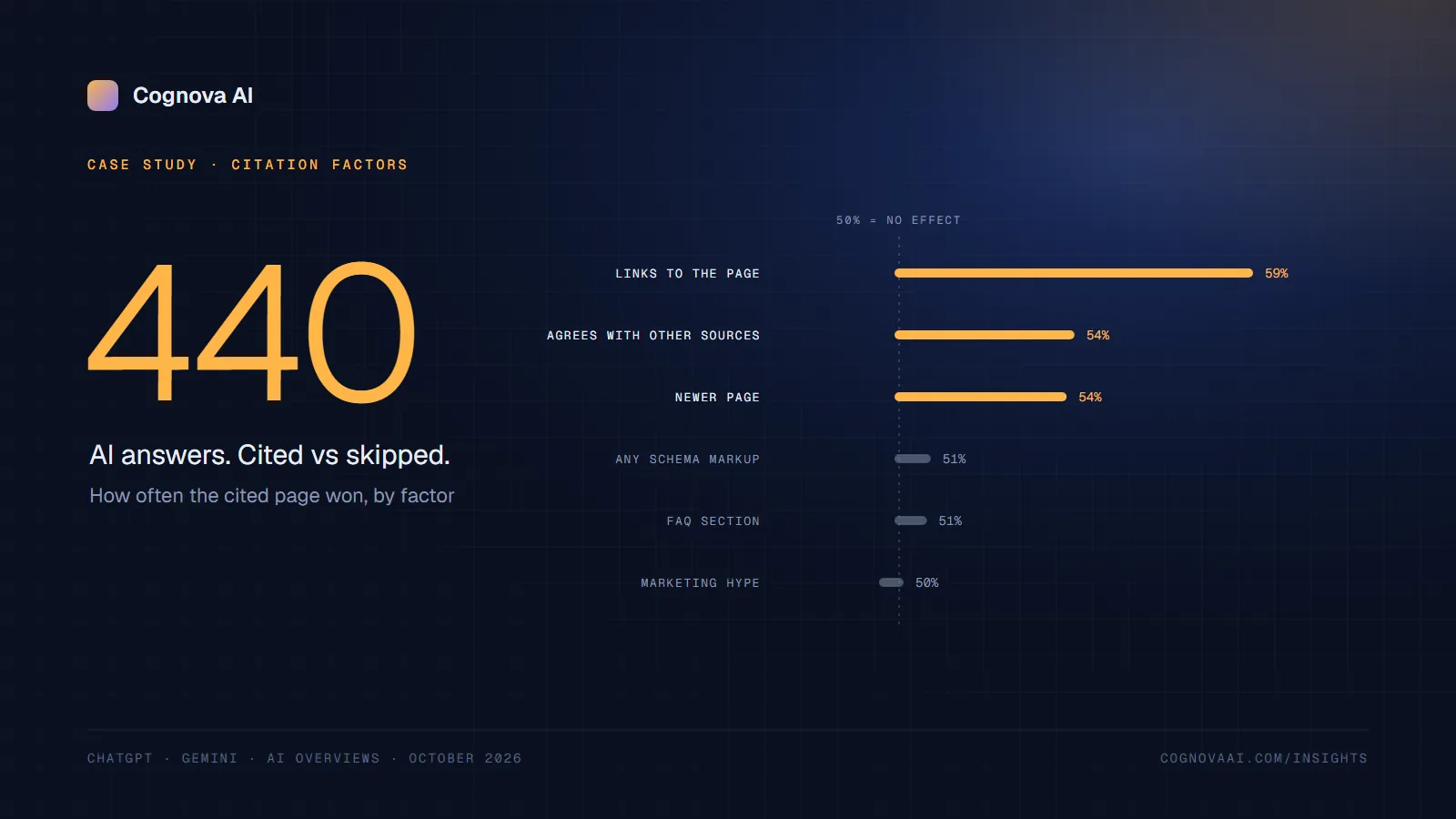
We studied 440 AI answers in which ChatGPT, Gemini or Google AI Overviews cited some of the pages they read and skipped others, and compared those pages head to head. Links to the specific page were the clearest winner: in ChatGPT, the page with more sites linking to it was cited 62% of the time. Pages that agreed with the other sources also won. Formatting, tone, schema and llms.txt made little or no measurable difference.
- Client
- Cognova AI research (our own study)
- Industry
- AI search (GEO and AEO), AI voice agent category
- Size
- 440 AI answers, 2,152 pages, 53 factors
Results
62%
ChatGPT cited the page with more sites linking to it
54%
Page that agreed more with the other sources was cited
4 vs 0
Sites linking to most-cited vs rarely cited pages (median)
440
AI answers compared head to head
The challenge
Most advice on getting cited by AI search comes from lab tests on rewritten pages, or from correlations across whole websites. Neither tells you why an AI engine, holding several relevant pages, cites one and skips another. We wanted that answer from real answers, so we could tell clients which changes are worth making and which are not.
The question matters for small businesses in particular. If formatting, schema or persuasive copy decide citations, those are cheap fixes. If links and reputation decide them, the work is different.
What we built
We used Peec AI to collect answers from ChatGPT, Google AI Overviews and Gemini for 96 prompts about AI voice agents, every day from October 22 to 27, 2026. In 440 answers the engine cited some of the pages it read and skipped others. For each of those answers we compared the cited pages with the skipped pages from that same answer, so the question, engine and day were identical and any difference came from the page itself.
We measured 53 factors per page: backlinks from SE Ranking, a technical crawl of each page, its text, structure, freshness, tone and wording, and how much it overlapped with the other pages the engine read. We then re-ran every test without the 15 most-cited sites, so a handful of dominant sites could not create a false effect.
“We expected formatting and structure to matter. Once an AI engine had read the pages, it barely noticed them. It cited the pages other sites vouch for and that agree with the rest, which changes where our clients should spend their time.”
How we measured it
The unit of the study is a single AI answer. When an engine answers a question with web search, it reads several pages and cites only some of them. Comparing cited and skipped pages from the same answer removes differences in topic, prompt, engine and day.
For each factor we report a head-to-head rate: how often the cited page beat a skipped page from the same answer, averaged over answers, with a 95% bootstrap interval. 50% means the factor makes no difference. We also fitted a conditional logit model with up to 28 factors together, corrected for testing many factors at once, and repeated every test without the 15 most-cited sites.
The data: 440 answers (262 ChatGPT, 96 Google AI Overviews, 82 Gemini), 1,839 cited and 5,133 skipped page appearances, 2,152 pages with stored text, 2,062 pages crawled for technical checks, and backlink counts for 790 pages.
Results
| Factor | Cited page wins | Without the 15 biggest sites | Verdict |
|---|---|---|---|
| More sites linking to the page | 59% (55–63%); ChatGPT 62% | 57% (51–62%) | Helps |
| More overlap with the other pages read | 54% (52–57%) | 54% (51–57%) | Helps |
| Newer page | 54% (51–58%) | 52% (48–56%) | Helps, partly driven by big sites |
| Published by a vendor in the category | 53% (51–54%) | 50% (48–51%) | Proxy for a few big vendors |
| Site has llms.txt | 52% (50–53%) | 51% (49–53%) | No reliable effect |
| Question-style headings | 53% (50–55%) | 55% (52–58%) | Helps smaller sites |
| Title matches the question | 51% (49–53%) | 54% (51–57%) | Helps smaller sites |
| Heavy ‘we and our’ voice | 48% (46–50%) | 46% (43–49%) | Hurts smaller sites |
| Unique content vs other pages read | 47% (45–50%) | 49% (45–52%) | No reliable effect |
| Any schema markup | 51% (50–52%) | 48% (46–50%) | No reliable effect |
| FAQ section | 51% (49–52%) | 52% (49–54%) | No effect |
| Tables | 50% (48–52%) | 52% (49–55%) | No effect |
| Readability | 50% (47–52%) | 51% (48–54%) | No effect |
| Positive tone | 51% (49–54%) | 49% (46–53%) | No effect |
| Marketing hype words | 50% (47–52%) | 48% (45–51%) | No effect |
| Social proof (reviews, ratings, customers) | 49% (47–51%) | 48% (45–51%) | No effect |
| First-hand testing claims | 48% (46–50%) | 50% (47–52%) | No effect |
| Statistics per 1,000 words | 50% (48–53%) | 51% (47–54%) | No effect |
| Page load time | 50% (48–52%) | 50% (47–54%) | No effect |
Across all pages, the 136 most-cited pages had a median of 4 sites linking to them and 14 days since their last update. The 348 pages the engines read often but almost never cited had 0 linking sites and 30 days since their last update.
Citation rate by page type
When a page was read in a mixed answer, discussions were cited 41% of the time, listicles 35%, how-to guides 33% and articles 31%. Product pages were cited 22% of the time, homepages 19% and comparison pages 17%.
What we did not find
The often-quoted lab result that adding statistics and quotations lifts AI visibility did not show up in real answers. Statistics were neutral and quotations slightly negative, and neither effect held without the biggest sites. Pages with llms.txt and vendor-published pages looked like winners at first, but both effects disappeared once the 15 most-cited sites were removed.
What happens next
We will repeat this study on more categories and over a longer period, and test the strongest findings by changing our own pages and comparing them with pages we leave alone. For the practical side of getting cited, see 7 Technical Fixes That Help AI Search Engines Cite Your Website.
How Cognova AI can help
We run this same analysis for a client's category: which pages AI engines read for your buyers' questions, which they cite, and what separates them. You get the pages and publishers to earn links from, the questions your content must answer, and a test plan that compares the pages we change with pages we leave alone.
See our GEO & AEO Consulting service, or book a call to talk through your category.
Frequently asked questions
What makes AI search engines cite a page?
In our study of 440 AI answers, links to the specific page were the clearest factor in whether AI search engines cited it over other pages they read. Pages that agreed with the other sources also won more often, and newer pages had a small edge. Formatting, tone, schema markup and llms.txt made little or no measurable difference once a page was on the engine's shortlist.
How was this AI citation study done?
We collected answers from ChatGPT, Google AI Overviews and Gemini for 96 prompts over six days in October 2026. In each of 440 answers, we compared the pages the engine cited with the pages it read and skipped in that same answer, across 53 factors. We repeated each test without the 15 most-cited sites so a few dominant sites could not distort the AI citation results.
Does formatting help AI search engines cite a page?
Not in our data. FAQ sections, tables, summaries up front, headings and readability did not separate the pages AI search engines cited from those they skipped in the same answer. A 2026 study of 252,000 trials across six AI models reached the same conclusion. The one exception was for smaller sites, where question-style headings and a title matching the question helped slightly.
What are the limits of this AI citation study?
The study covers one category, AI voice agents, over six days, and most answers came from ChatGPT. Backlink data covers 790 of the 2,152 pages because our SE Ranking trial ran out of credits. Peec AI does not show where each page ranked in the engine's own search results, which likely explains part of the link effect. Tone was measured with word lists.
Sources
Cite this article
Cognova AI. (2026, October 31). What Makes AI Cite a Page: A Study of 440 AI Answers. Cognova AI. https://cognovaai.com/insights/what-makes-ai-cite-a-page-a-study-of-440-ai-answers
Permanent link: cognovaai.com/insights/what-makes-ai-cite-a-page-a-study-of-440-ai-answers. Quoting a passage? Select it and use “Copy quote” to get a link that jumps to that exact text.